
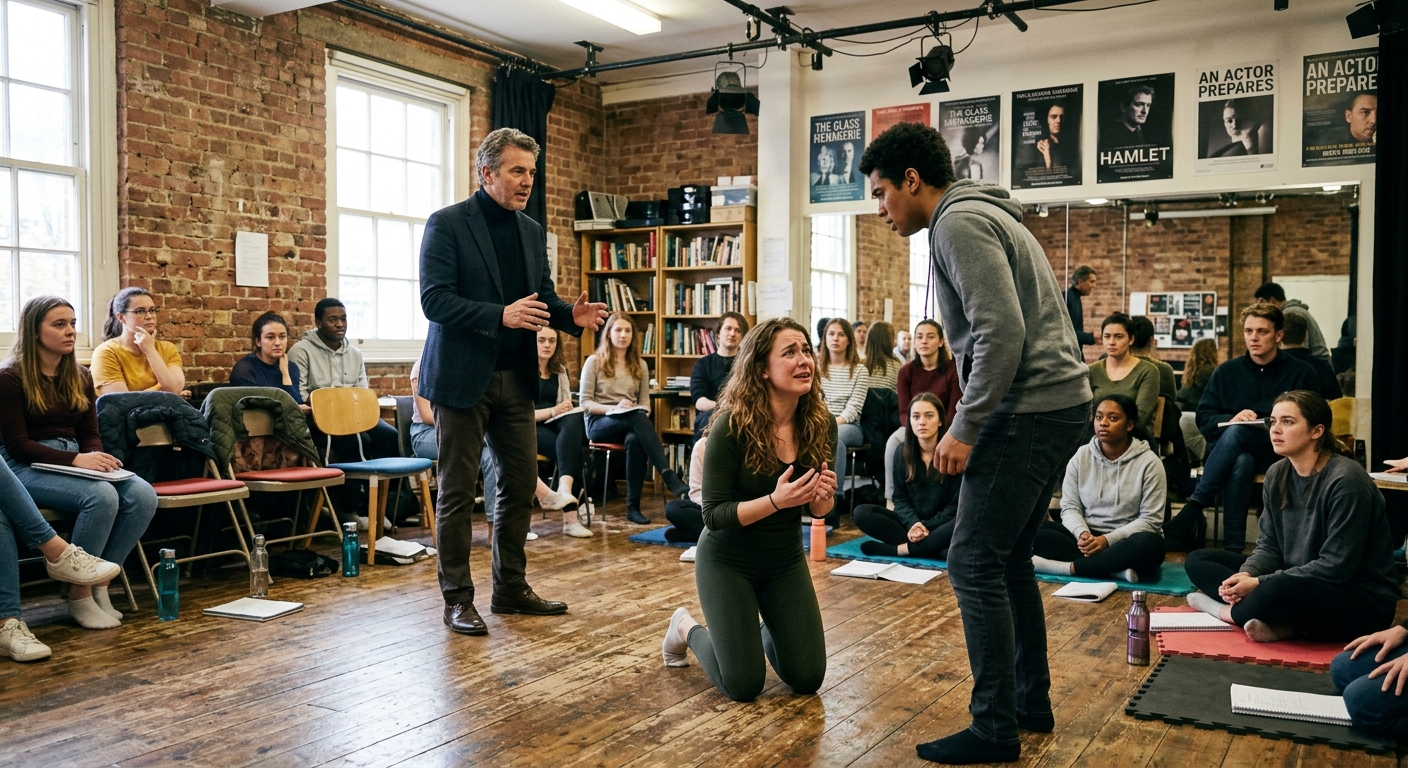
The Schools Where Actors Learn to Become Other People
The aspiring actor goes to school in order to learn how to stop pretending.
There is a peculiar contradiction at the heart of serious actor training. The aspiring actor goes to school in order to learn how to stop pretending.
For more than a century, the great acting schools of America and Europe have wrestled with this paradox. Should an actor construct a character through disciplined technique, or discover the character through instinct? Should the actor begin with the body, the voice, the text, the imagination, or the emotions? Is acting primarily an art of psychological truth, or of theatrical craft?
The answers have produced schools, rivalries, vocabularies, and occasionally something approaching theology.
The names remain familiar: Stanislavski, Strasberg, Adler, Meisner, Chekhov, Brecht. But the institutions that inherited these traditions have changed considerably. Contemporary conservatories tend to be less doctrinaire than their predecessors, combining techniques rather than insisting upon a single orthodoxy.
Still, the old philosophies remain visible.
Juilliard: the American synthesis
The Juilliard School occupies an almost mythological position in American actor training.
Its philosophy is less a single method than a demanding synthesis. Students receive intensive work in voice, movement, text, physical training, and performance, with the objective of developing what Juilliard describes as an embodied understanding of the actor’s craft. Its current MFA program is four years, unusually long by American graduate-school standards, and includes movement, voice and speech, Alexander Technique, rehearsal, and production.
The underlying idea is that acting is not merely psychological.
The actor must have an instrument.
Juilliard therefore belongs to a distinctly theatrical tradition. It expects actors to understand Shakespeare and contemporary drama, but also to understand what the body is doing in space and what the voice is doing to an audience.
There is something almost old-fashioned about this insistence on craft. In an era when screen acting can appear to reward understatement above all else, Juilliard continues to train actors for the possibility that they will have to fill a room.
The school has also become considerably more accessible financially: its MFA Acting program is currently tuition-free, with a living stipend in the fourth year.
Yale: the actor as intellectual
David Geffen School of Drama at Yale approaches acting from a somewhat different direction.
Yale’s actor is not simply an instrument but an interpreter.
The program emphasizes imagination, intelligence, collaboration, physical and vocal development, and extensive production experience. Its current curriculum also explicitly incorporates anti-racist and anti-oppressive pedagogies.
The Yale tradition has historically been particularly strong in the relationship between acting and dramatic literature. An actor is expected to understand what a playwright is doing before attempting to embody it.
This produces a certain kind of theatrical seriousness.
The actor is not merely asking, How do I feel this?
The actor is asking, What is this play doing? What does this character want? What does the language conceal? What does the scene require of an audience?
It is a distinction that sounds academic until one sees it performed well.
Then it looks like instinct.
NYU Tisch: the laboratory
NYU Tisch School of the Arts may be the most conspicuous institutional argument against the idea that there is one correct way to act.
Tisch Drama contains multiple professional training studios, including programs associated with Meisner, Stella Adler, Lee Strasberg, Atlantic, classical acting, experimental theater, and screen acting.
This is significant.
Instead of telling an actor, Here is the method, Tisch effectively says: Here are several traditions. Discover what your instrument requires.
The Meisner studio, for example, explicitly derives its work from Sanford Meisner’s famous conception of acting as truthful behavior under imaginary circumstances. Students work intensively on responsiveness, repetition, listening, movement, voice, and scene work.
Tisch’s graduate acting program takes the experimental impulse even further. Its philosophy describes the actor as an “Artist/Citizen” and combines rigorous studio training with production and engagement with New York’s artistic life.
The result is less a school of acting than a small city of acting schools.
RADA: the authority of the text
Across the Atlantic, Royal Academy of Dramatic Art represents one of the great British traditions.
Founded in 1904 by actor-manager Herbert Beerbohm Tree, RADA was created explicitly as an institution for professional theater. Its modern curriculum continues to emphasize acting technique, Shakespeare, text analysis, stage presence, devising, and contemporary scene study.
The British conservatory tradition historically placed enormous importance on text and voice.
The actor must know how to speak the language.
Not merely pronounce it.
Understand its rhythm. Its architecture. Its rhetorical force. Its social implications. Its poetry.
This is particularly important in Shakespeare, where an actor who treats the language as decorative can easily lose the character inside it.
RADA therefore represents an idea that can seem almost alien to some American method traditions: emotional truth does not necessarily precede theatrical form. Sometimes form is what releases emotion.
LAMDA: the contemporary conservatory
London Academy of Music & Dramatic Art occupies a similarly prestigious place in British training but has developed a particularly broad contemporary orientation.
Its MFA Professional Acting program describes itself as rigorous conservatoire training combined with postgraduate professional projects, with extensive small-group teaching and individualized feedback.
LAMDA’s significance lies partly in its ability to combine traditions.
The actor might encounter classical text, contemporary drama, movement, voice, screen work, and professional rehearsal practices without being required to identify permanently with one “method.”
That reflects a larger transformation in acting education.
The old wars between Method and anti-Method have become less useful.
Today’s professional actor may need Stanislavski’s psychological analysis in one production, a highly physical approach in another, classical vocal technique for Shakespeare, and a radically restrained technique for a close-up.
The successful actor becomes multilingual.
Bristol Old Vic: acting as ensemble
Bristol Old Vic Theatre School represents another important strand of British training: the actor as member of a theatrical company.
The school was established in 1946 alongside the Bristol Old Vic and has maintained an unusually strong connection to practical professional training. Its postgraduate offerings include professional acting, voice, screen acting, directing, writing, and design.
Its philosophy emphasizes collaboration as much as individual virtuosity.
That matters because theater is inherently communal.
The actor does not perform alone. Even the apparently solitary business of inhabiting a character occurs within a system of directors, designers, other actors, technicians, writers, and audiences.
The Bristol tradition consequently treats professional preparation as something more expansive than learning to deliver a monologue.
It teaches actors how to work.
The European conservatoire: another idea of the actor
The European tradition becomes harder to summarize because Europe does not possess a single acting culture.
France has its conservatoire tradition. Germany has its Schauspielschule and Schauspielhaus culture. Russia’s influence remains enormous. Poland, the Czech Republic, Italy, and the Nordic countries have developed their own approaches.
But there is a broad distinction worth making.
The American acting school historically became fascinated with psychology.
The British school became fascinated with language and craft.
Much of continental European training has often been more interested in the actor’s physical and theatrical relationship to space, ensemble, and form.
That distinction is necessarily simplified, but it helps explain the continuing influence of figures such as Bertolt Brecht, Jerzy Grotowski, Vsevolod Meyerhold, and Jacques Lecoq.
Paris and the French tradition
Conservatoire national supérieur d’art dramatique belongs to the great European conservatoire tradition.
Its history stretches back to the eighteenth century, and its philosophy has historically been tied to the French theatrical tradition of voice, diction, classical repertoire, physical presence, and rigorous studio training.
But France also produced one of the twentieth century’s great revolutions in actor training through Jacques Lecoq.
Lecoq’s approach began not with psychology but with the body.
How does an actor walk?
How does a character occupy space?
What happens when movement precedes language?
How can mask, mime, clowning, improvisation, rhythm, and physical composition generate character?
The Lecoq tradition remains enormously influential in European physical theater.
It represents almost the opposite pole from the caricature of Method acting.
Instead of asking an actor to dig inward, it sometimes asks the actor to move outward—to discover character through physical action.
Berlin and the European laboratory
Ernst Busch University of Applied Sciences is another major institution in the European landscape, particularly significant within German theater and physical-performance traditions.
German acting education has historically been influenced by a theater culture in which the actor is not necessarily expected to disappear completely into psychological character.
Brecht is the obvious counterexample to the Stanislavskian ideal of complete identification.
The Brechtian actor may demonstrate a character as much as inhabit one.
The audience is not supposed to forget that it is watching theater.
This is sometimes called the Verfremdungseffekt, or alienation effect: theatrical techniques interrupt identification so that spectators think about what they are seeing rather than simply surrendering emotionally to it.
That idea has influenced generations of European performers, directors, and theater makers.
The ghost of Stanislavski
Almost every serious discussion of modern acting eventually arrives at Konstantin Stanislavski.
His influence is so pervasive that the word “method” can obscure how complicated his actual work was.
Stanislavski developed a systematic approach to acting centered on objectives, circumstances, physical action, concentration, imagination, and truthful behavior. His ideas traveled to America and were transformed by teachers including Lee Strasberg, Stella Adler, and Sanford Meisner.
But those American teachers did not teach identical systems.
Strasberg emphasized emotional memory and psychological access.
Adler reacted strongly against over-reliance on personal emotional experience, emphasizing imagination, circumstances, action, and the world of the character.
Meisner emphasized listening and truthful response.
Thus the famous “Method” is less a single method than a family tree.
And modern conservatories have increasingly become the family reunion.
The most interesting development: the end of orthodoxy
Perhaps the greatest change in actor training is that the great schools are less interested than they once were in convincing students that one technique contains the whole truth.
The contemporary actor may study Meisner and Shakespeare.
Stanislavski and physical theater.
Alexander Technique and screen acting.
Voice and improvisation.
Classical rhetoric and contemporary naturalism.
This is not necessarily a weakening of tradition.
It may be the maturation of tradition.
The actor working today faces a remarkable range of demands. A theater actor may need the projection and physical command of classical stagecraft. A film actor may need the microscopic control required by a close-up. A television actor may have to work rapidly, sometimes with incomplete scripts. A performer in experimental theater may need to create work rather than merely interpret it.
No single method can reasonably claim jurisdiction over all of that.
The best schools therefore seem to be moving toward a more pluralistic conception of technique.
What the great schools are really selling
Prestige is part of it.
So are connections.
So is access to directors, casting professionals, agents, fellow actors, and professional productions.
But the deeper commodity is time.
A serious conservatory gives an actor several years in which failure is permissible.
That may be its most valuable service.
The young actor can attempt Shakespeare badly. Discover that Meisner makes sense—or doesn’t. Learn that the voice is weak. Discover that movement is awkward. Find out that comedy is unexpectedly natural. Discover that a supposed strength is actually a limitation.
There is no audition tomorrow.
There is only class.
That is an extraordinary luxury in professional acting.
And perhaps that is why the great acting schools remain important despite the proliferation of workshops, online courses, private coaches, and celebrity master classes.
They offer something that cannot easily be purchased piecemeal: a sustained argument about what an actor is.
Juilliard says, in effect, that the actor is an embodied craftsman.
Yale emphasizes the intelligent, imaginative interpreter.
Tisch proposes an artist capable of moving among traditions.
RADA insists upon craft, text, and professional discipline.
LAMDA combines conservatory rigor with contemporary professional practice.
Bristol Old Vic emphasizes ensemble and practical theatrical life.
The continental traditions remind the actor that the body, space, theatrical form, and the audience can be as important as psychological identification.
And behind all of them stands Stanislavski, still haunting the room.
The remarkable thing is not that the schools disagree.
It is that, after more than a century of argument, they still agree on one thing: acting is not simply the ability to pretend to be someone else.
It is a discipline for discovering what human behavior looks like when another person is watching.