BACK WHEN WE COULD PLAY TOGETHER
Have our minds and souls been altered by only passive engagement with music?
I am trying to imagine what it used to be like.
You don’t have to go back far in history to reach that point where my family is not much different from yours. I am talking about the time before electronic media, back in the late 1800s.
Our families, I sense, were alike back then in the sense that entertainment, diversion from the boring day-to-day task of mere survival, was not passive, as it largely is today, but instead required a level of active engagement.
No radio, no TV, no movies to go to, people used to read, then get together to talk about it. They used to attend regular Chautauqua sessions, where the educated and the erudite – I am assuming all this – presented programs and lectured to regular folk hungry for information about the broader world.
Back then, there was no such thing as a “mobile America”, as we have today. People generally didn’t get that far away, geographically-speaking, from where they were born.
So, in that context, my family and yours were alike in the sense that we all had relatives – family members – who could entertain us through their musicality. Grandpa, grandma, Uncle Hoot and Aunt Castor, and many of their children played fiddles and banjos and pianos and fashioned rhythm instruments, and they played together. The sang and danced.
Sounds kind of horrible, doesn’t it? Today, when people have TV and “America’s Got Talent” and “Dancing With the Stars” and “The Voice”, next to no one can sing and dance and play.
I find that weird. We have become a world of sometimes spasmodically-moving-and-bobbing watchers.
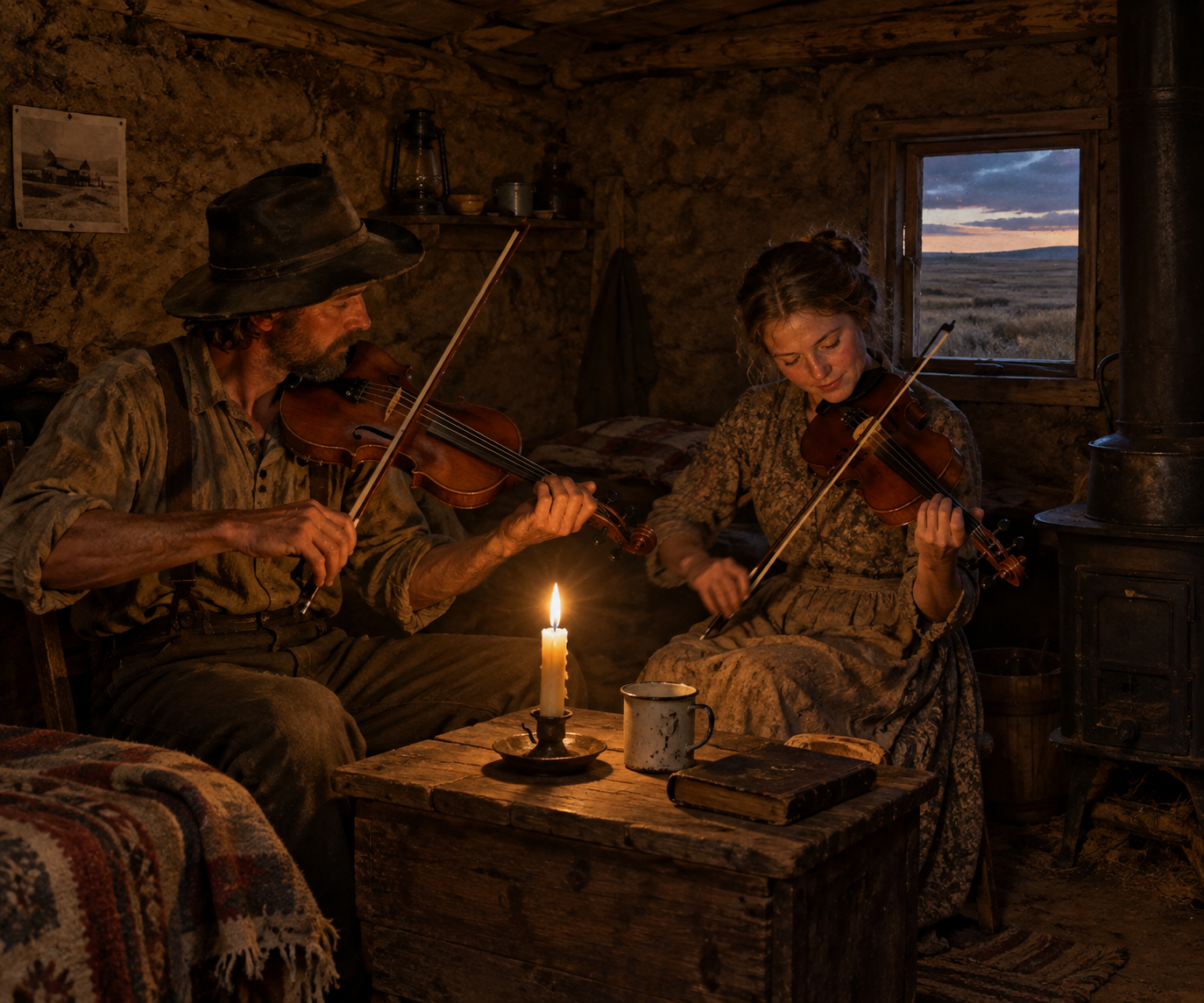
My Great-Grandfather C.J. Rice played the fiddle. Sitting there in his homesteader home, fashioned from sod, usually alone, he played the fiddle and he wrote poems and letters, and occasionally a neighbor would drop by with his fiddle, and the two would play into the night. And sometimes families would get together and other people would join in with their instruments and they would have a barn dance.
My Grandfather John Frick – my mom’s dad – played the fiddle and called square dances. That fiddle was passed down to me, somewhat tragically, as I lost it in a house fire.
I tried to replace that fiddle, in our family history, by buying a new violin, which I gifted to my son, who is a naturally gifted musician (and graphic artist) and I don’t think he has ever opened the case. I take that back. He got the violin out once, broke a string, put it back in the case, and there it has now lived for years, forgotten.
The thief of time has saved us from knowing what we have lost by becoming passive consumers of commercial music and by forgetting that “we” don’t need to be that way.
You use it or you lose it. That’s a simple fact of life that applies to virtually everything. You are what you do, as opposed to being some mental construct, some imaginary savant you witness alone in your own mind.
As I take this dream journey back in time, to when creativity marshalled against the cruelties of life and reality, as opposed to today’s commercial sensibilities, when a carefully curated community of star performers exploit pain and suffering, I wonder how the past worked.
Musicians are not all equal. People develop skills at different paces, and some have high-end talent to work with, and some don’t.
My experience playing with other musicians, of various levels, is that playing together does not come easily, when it seems like it should be natural. Mind you, I have always been in the context of today, when I think we treat musical aspirants differently – treat all of our human brothers differently – than we did yesterday. We are very judgmental today, myself included.
Everyone feels the beat. We are all moved by rhythm. One might think that alone would allow musicians of all levels to just fall right into a groove together and take musical flight, but it doesn’t work that way, at least not now.
I wonder how organic music ever worked, though we all know from our own family histories that it did. Maybe some of us still have the joy of a family and friend group who come together in informal playing sessions and just feel the lift, the wonder of playing together.
Maybe that ability to play together – a feat that now must be practiced and earned – has been largely lost to us because we stopped doing it.
Think of the impact of that societal change on virtually every aspect of our human experience.
People today feel isolated and lonely, even though football is on tonight, as is a divisive and ill-considered political TV event.
We’ve become a type of bird afraid to sing for fear of being canceled by other birds who don’t like regular birds being birds.
In human terms, we’ve become a species that puts down banjo, fiddle and accordion players, because it’s funny, and we’ve become mortified by the sound of an untrained human voice. It all embarrasses us, makes us uncomfortable.
There was a time, in human history, when peasants were uneducated and only the socially elite had the privilege of cultural advancement, of learning to play musical instruments, and to compose music, and to sing.
In unenlightened times, only the royal courts and the grand opera halls had music, but then a revolution occurred.
It happened through the establishment of ribald places like the Globe Theater, which let the hoi polloi in, as opposed to just the cultured elite.
The poor, the wretched refuse, began to sing, in their untrained voices, where previously singing was something restricted to those elites trained in opera. And after that, peasants around the countryside somehow started fabricating musical instruments, and somehow, they began to figure out how to play music themselves.
They could respect the educated elites, the masters of craft, but they no longer needed them. Somewhere some Irish kid gained access to a fiddle, and through economic necessity, he migrated far from home, to the plains of a Kansas Territory that would one day be called Nebraska. And there he lived alone, for a time, playing lonely in the night, recording notes in his journal.
And occasionally a neighbor would show up carrying his fiddle, and the two would find a connection to each other and to whatever magical force it is that exists in this world in the form of music.
Maybe they weren’t that good, I don’t know, I wasn’t there. But I know it gave them joy, because I have my Great Grandfather’s journals, and he wrote eloquently about it.
It feels to me, especially when I see the curated acts on television, that we have lost something at the very heart of what music is able to give us.
Maybe instead of the U.S. government running commercials trying to gin up enthusiasm for war we should be running commercials trying to gin up enthusiasm for Chautauqua institutions, where we could find lift rather than aggression.
Maybe we should call a dance.
– RAR