
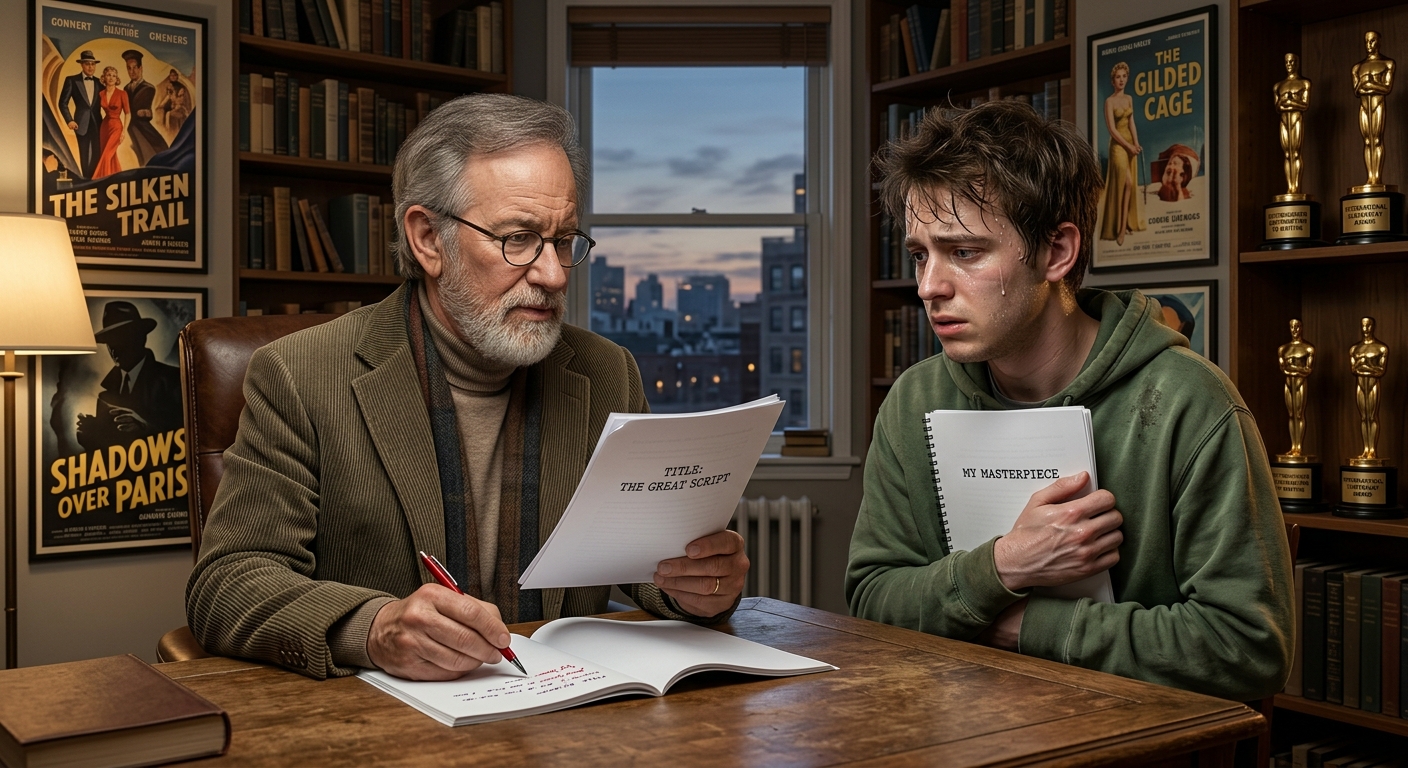
The Business of Being Read
There was a time when the aspiring screenwriter’s greatest problem was getting somebody to read the script.
Now there are almost too many somebodies.
Upload a screenplay to one of the new artificial-intelligence services and, sometimes before the coffee has cooled, a report appears: logline, synopsis, character analysis, structural diagnosis, pacing assessment, genre comparisons, market observations, perhaps even a numerical score. Send the same script to a human coverage service and a professional reader may return several pages of notes, identifying what works, what doesn’t, and what might persuade a producer to keep reading. Pay considerably more and a working screenwriter may sit down with the author every week, draft after draft, becoming something between editor, teacher, therapist, and producer.
Around the screenplay has grown a peculiar secondary industry devoted to helping people write the thing that Hollywood itself may or may not buy.
It is not entirely new. Hollywood has always employed readers. Every studio, agency, management company, and production company has had some version of the development process in which somebody reads a script, summarizes it, assesses it, and decides whether it deserves another afternoon. Independent coverage services merely opened that process to writers who otherwise would have no access to it.
What is new is the scale, the consumerization, and now the machinery.
The writer can buy a reading almost as easily as a novelist can buy an editor. The writer can obtain three opinions instead of one. He can ask a machine to identify structural problems before paying a human being. He can hire a mentor to accompany him through the rewrite. He can enter contests that promise not merely prizes but introductions to managers and producers. And, in some cases, he can buy something tantalizingly close to a development department without ever entering a studio.
The result is a new economy built around a peculiar Hollywood paradox: the screenplay is extraordinarily difficult to sell, but there has never been more opportunity to pay someone to tell you why.
The reader in the shadows
Screenplay coverage was originally a backstage function.
A development executive did not have time to read everything that arrived at a studio. A producer could not personally examine every unsolicited script. So the reader became a gatekeeper. The reader would summarize the story, identify strengths and weaknesses, and provide a recommendation—typically something like Pass, Consider, or Recommend.
That system remains fundamental to Hollywood.
But eventually the reader’s knowledge became a commodity available to writers themselves.
The logic was simple. If a professional reader could tell a producer that the second act collapsed, the protagonist was passive, the concept was familiar, or the ending failed to deliver, why shouldn’t the writer hear that criticism before the producer did?
Companies such as Scriptapalooza, which has offered coverage since 2002, helped formalize the service for independent writers. Coverage Ink developed another version of the model, emphasizing experienced human readers and actionable notes. Script Reader Pro has expanded the idea further, offering coverage, mentoring, rewrites, editing, and other services.
A small but consequential change occurred in the transaction.
The reader was no longer being paid by the studio to determine whether a script deserved development.
The reader was being paid by the writer to help make the script worthy of development.
That distinction is everything.
A studio reader’s primary customer is the studio. An independent coverage service’s customer is the writer. A good service can still provide an honest professional assessment; indeed, honesty is its principal product. But the incentives are different, and the writer should understand them.
Then came the mentors
Coverage answers a question:
What’s wrong with my script?
Mentorship attempts to answer another:
What do I do about it?
That is a much more expensive proposition.
A coverage report may arrive as a PDF. Mentorship is a relationship. The writer submits material, talks with the mentor, rewrites, returns, argues, experiments, fails, and tries again. Some programs provide weekly meetings and structured milestones. Script Reader Pro, for example, currently advertises mentorship beginning at substantially more than its basic coverage service, with ongoing video sessions and individualized development.
The best mentoring programs understand something that a report cannot easily convey: screenwriting is not merely a technical problem.
A writer may know that the second act is slow and still have no idea what to do about it. He may be told that the protagonist lacks agency without understanding that the real problem is that the protagonist has no sufficiently difficult choice to make. He may be instructed to “raise the stakes” when what the screenplay actually needs is a more interesting contradiction.
A mentor can interrogate the problem.
That is potentially valuable.
It is also where the industry becomes more difficult to evaluate, because “mentor” is not a standardized professional credential. A writer may be paying a genuine working screenwriter with produced credits. Or a talented reader with extensive industry experience. Or somebody who has simply become good at selling the appearance of expertise.
The résumé matters.
So does the mentor’s ability to explain why a change should be made rather than merely prescribing one.
Artificial intelligence enters the reading room
The AI version of the business arrived with a different promise: speed and scale.
Services now advertise complete coverage in minutes. Callaia, for example, offers automated reports covering premise, originality, dialogue, structure, logic, tone, conflict, pacing, characters, comparisons, and market positioning. Other services have built similar products.
The economic proposition is obvious.
A human reader needs time. A machine does not.
Current services consequently occupy different price points: inexpensive automated reports, conventional human coverage, and considerably more expensive hybrid or mentoring arrangements. Industry comparisons now routinely describe AI coverage as dramatically cheaper and faster than human analysis.
But speed is not the same thing as judgment.
AI is quite good at recognizing patterns. It can identify a protagonist who disappears for thirty pages. It can notice repeated information. It can summarize a complicated plot. It can compare the apparent structure of a script with familiar storytelling conventions.
What remains harder is determining whether the writer has violated a convention deliberately—and whether the violation is the interesting thing.
A screenplay can be badly structured and brilliant. It can be conventionally structured and dead.
That is the fundamental limitation of automated criticism: the machine can become extremely good at describing what a screenplay resembles without necessarily understanding why its strangeness might matter.
This does not make AI coverage useless. Quite the opposite. Used early, it may be a remarkably inexpensive diagnostic instrument.
But there is a danger in treating a score as a verdict.
The number is not the movie.
Does any of this actually sell screenplays?
Here the industry’s claims require careful parsing.
There are legitimate examples of writers using competitions, development programs, coverage services, and mentorships to obtain representation or industry meetings.
Script Pipeline, for instance, says its writers have sold more than $8 million in screenplays and pilots and cites produced projects among its alumni. Its model combines competition, development, mentorship, and circulation to industry professionals.
Coverage Ink says its Get Repped Now program has produced more than ninety meetings and eleven writer signings, along with a major studio sale.
These are meaningful outcomes.
They are not, however, evidence that purchasing coverage causes a screenplay to sell.
That distinction is essential.
A service can legitimately produce meetings without being a machine for producing careers. A competition can have successful alumni without making success probable for every entrant. A mentor can materially improve a screenplay without having any ability to sell it.
The entertainment business remains radically selective.
The strongest service providers themselves acknowledge this. Script Reader Pro explicitly says it cannot guarantee an agent, manager, sale, or contest victory and warns writers to be suspicious of anyone who does.
That may be the most important sentence in the entire industry.
No legitimate screenplay consultant can guarantee a sale.
The problem with getting too many opinions
A writer who has finally completed a screenplay experiences a temptation familiar to anyone who has made something difficult: ask somebody else whether it is good.
Then ask somebody else.
Then somebody else.
This can become expensive—and creatively dangerous.
Suppose three readers independently identify the same problem. The writer should probably listen.
Suppose one reader hates the protagonist, another loves her, and a third thinks she is fine but the ending is weak. That is not necessarily a contradiction that must be resolved. It may be information about the script’s subjective qualities.
And suppose five readers all recommend the same conventional solution.
That does not necessarily mean they are right.
It may mean the screenplay is broken. But it may also mean that five professional readers have been trained to recognize the same commercial conventions.
The writer’s task is not to obey the coverage.
It is to interpret it.
For that reason, one excellent reader is generally more useful than five mediocre ones.
There is nevertheless a strong case for a second opinion after a substantial rewrite. The first reader may have identified a structural problem; the writer may have fixed it; a second reader can determine whether the solution created a new problem.
The useful sequence is therefore not:
Reader → Reader → Reader → Reader → Reader.
It is:
Draft → Reader → Rewrite → Reader → Rewrite → Market.
The screenplay should change between readings.
Otherwise the writer is simply collecting opinions.
The mentor question
Mentorship can be worthwhile, particularly for writers who are still learning the craft or who have reached the point at which they can diagnose problems but cannot solve them.
It is less valuable when the writer already has a highly developed process and primarily needs an honest industry read.
A good mentor should make the writer increasingly independent.
A bad mentor makes the writer increasingly dependent.
That distinction is subtle. The best mentors don’t simply rewrite the screenplay in their own image. They teach the writer how to recognize the problem so that, on the next screenplay, the writer can solve it without them.
The strongest structured programs can also provide something that ordinary coverage cannot: access to other writers and, occasionally, industry professionals. CineStory, for example, combines script development with one-on-one sessions involving working entertainment professionals. The Writers Lab similarly combines craft development with career guidance and industry interaction.
There is another advantage to a good mentor: continuity.
A reader sees a screenplay.
A mentor may see the writer.
That can matter.
The question nobody wants to ask: Who owns the script?
Writers understandably worry about sending an unpublished screenplay into the electronic ether.
The fear is often expressed as theft: What if somebody steals my idea?
The more practical questions are usually less dramatic.
Who has access to the file?
Is it stored on the company’s servers?
For how long?
Does the company’s privacy policy permit the material to be used for internal analysis, product development, or model training?
Does the service employ third-party AI providers?
Can the writer delete the file?
What happens to uploaded material after the account is closed?
Those questions become particularly important with AI services because the screenplay is not merely being read by an employee. It may be processed by a technical system whose data practices are governed by terms the writer has not carefully examined.
The writer should therefore read the service’s privacy and intellectual-property terms before uploading anything commercially valuable.
This is not paranoia. It is ordinary professional hygiene.
There is also a second risk: premature exposure.
A writer may submit a screenplay to ten competitions, five coverage companies, three mentors, and an online pitch service, accumulating an impressive trail of submissions before the screenplay is actually ready.
That can dilute the writer’s own judgment and, depending on the venue, place the work into public or semi-public databases.
The safest general principle is simple:
Don’t circulate a screenplay merely because you have finished writing it. Circulate it because you have finished developing it.
So who are the best?
There is no objective league table. “Best” depends on what the writer needs.
For human coverage, Script Reader Pro and Coverage Ink are established examples of services built around professional readers rather than automated analysis. Script Reader Pro emphasizes working screenwriters and allows writers to choose among readers; Coverage Ink has built its identity around human analysis and explicitly rejects AI coverage.
For AI-assisted coverage, services such as Callaia represent the new generation: rapid, inexpensive, structured analysis intended primarily as a development tool rather than a substitute for a producer’s judgment.
For development plus industry exposure, Script Pipeline is notable because its model extends beyond a report: development, mentoring, circulation, and introductions are part of its stated program.
For structured mentorship, CineStory and programs such as The Writers Lab offer something closer to an intensive workshop or professional development experience than a conventional paid reading.
And Scriptapalooza remains notable precisely because it represents the older human-reader model in an increasingly automated field. It explicitly advertises that it does not use AI for its coverage.
The point is not that one of these organizations will somehow open the gates of Hollywood.
The point is that they perform different jobs.
What should happen after the notes arrive?
This may be the most important question.
The writer receives the report. There is often a peculiar moment of silence.
The screenplay, which seemed finished yesterday, is suddenly covered in red flags.
The reader says the protagonist is passive. The dialogue is on-the-nose. The second act sags. The concept is commercial but insufficiently distinctive. The ending doesn’t deliver. The characters lack dimension.
The writer now has two choices.
He can fix everything.
Or he can figure out which problems actually matter.
The second choice is better.
A useful development process begins by sorting the notes into categories.
Structural notes: Does the story work?
Character notes: Do the characters want something, make choices, and change—or fail to change—in compelling ways?
Concept notes: Is there a reason for somebody to want to make this movie?
Execution notes: Are scenes, dialogue, pacing, and description accomplishing what they should?
Market notes: Is the script realistically positioned for the kind of movie being imagined?
Then comes the hardest step: deciding which notes to reject.
A writer who implements every suggestion eventually produces a screenplay written by committee.
The goal is not to make the reader happy.
The goal is to discover whether the reader has identified a problem that the writer himself can solve.
The screenplay-development industry may be the real Hollywood of the twenty-first century
Something larger is happening here.
Hollywood has always been a development business. What has changed is that the development process itself is being sold directly to consumers.
The aspiring screenwriter can now purchase access to forms of expertise once available primarily inside studios and agencies: professional coverage, story analysis, pitch preparation, mentoring, market positioning, rewriting, and sometimes introductions.
AI accelerates the process.
Human readers legitimize it.
Mentors personalize it.
Competitions add the possibility of discovery.
The entire ecosystem exists because there is an enormous gap between writing a screenplay and having a career as a screenwriter.
That gap has always existed.
What is new is the number of businesses offering to help writers cross it.
Some will provide genuine value. Some will provide useful criticism at a reasonable price. Some will provide little more than encouragement packaged as professional development. A few may be genuinely consequential. None can repeal the fundamental economics of Hollywood.
The writer, therefore, should approach the industry neither cynically nor credulously.
A screenplay is not a lottery ticket, and coverage is not a lottery number.
A good reader can tell you that your screenplay has a problem.
A good mentor can help you understand the problem.
A good contest or development program can, occasionally, put the screenplay in front of someone who matters.
And a good AI system can give you a remarkably cheap first pass over the manuscript.
But eventually the writer must return to the lonely part.
The notes disappear.
The mentor hangs up.
The algorithm stops generating observations.
The industry stops talking.
There is only the screenplay, and the writer sitting in front of it, deciding what the movie is actually trying to become.
That remains, for all the machinery that has accumulated around it, the part nobody can outsource.