
Hollywood’s Great Migration: Has the Entertainment Industry Really Abandoned Los Angeles for New York?
The story of American entertainment’s changing geography is more complicated than a mass exodus to Manhattan. Hollywood is losing work, but the beneficiaries include a collection of cities across the United States and beyond. The forces driving that change may permanently alter the economics—and the culture—of making movies, television, and recorded music.
For generations, Los Angeles was more than the capital of the entertainment industry. It was the place where the industry’s entire ecosystem came together: studios, sound stages, recording facilities, production crews, equipment houses, postproduction specialists, agents, executives, and the thousands of people whose work made the business function.
New York had its own formidable entertainment economy, built around television, advertising, theater, independent film, and music. But when Hollywood contemplated a major motion picture or an ambitious television series, the gravitational pull of Southern California was difficult to resist.
That arrangement is changing.
Production companies are increasingly willing to film in Atlanta, New York, Toronto, London, and other places that offer some combination of financial incentives, modern facilities, experienced workers, and lower costs. Streaming services have changed the economics of production. The pandemic disrupted established routines. Labor disputes interrupted schedules in 2023. And California, once the unquestioned center of American production, has struggled to compete with governments willing to subsidize the cost of making entertainment.
But the claim that recording, film, and television companies have simply abandoned Los Angeles for New York is misleading. There is no single migration, and the three industries do not follow the same patterns. Film and television production, in particular, have become geographically dispersed. Recording music follows a different set of economic and technological rules.
The more revealing question is not whether Hollywood has moved to New York. It is whether Los Angeles can continue to command the premium it once enjoyed for being Hollywood.
The numbers tell a more unsettling story
The strongest evidence of Hollywood’s difficulties comes from two different measurements: how much filming actually takes place in Los Angeles, and how often its sound stages are occupied.
Those measurements tell related but different stories. A production may rent a stage for months without filming on Los Angeles streets, while a film made on location may never occupy a conventional sound stage. Neither measure alone captures the entire industry.
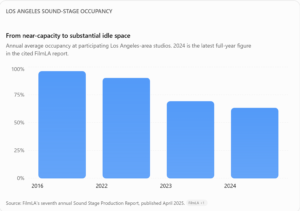
The numbers are striking:
-
2016: 96 percent occupancy. Los Angeles stages were close to full utilization.
-
2022: 90 percent. Even before the full consequences of the labor disputes became apparent, the market remained strong.
-
2023: 69 percent. The writers’ and actors’ strikes, combined with a contraction in production spending, left substantially more stage space unused.
-
2024: 63 percent. Occupancy fell further, meaning that, on average, more than one-third of the measured capacity sat unoccupied.
FilmLA+1
These figures are not a measurement of the entire Los Angeles entertainment economy, nor do they mean that 37 percent of studios permanently closed. They describe average occupancy among participating facilities.
The broader picture was no more encouraging. In January 2026, FilmLA reported that on-location film and television production in greater Los Angeles had fallen to 19,694 shoot days in 2025, down 16.1 percent from 23,480 in 2024. That was the lowest annual total since the pandemic-disrupted year of 2020.
Los Angeles Times
The decline is not merely a matter of Hollywood losing a few productions to rival cities. It reflects a business that has reduced the amount of content it commissions and has become more aggressive about deciding where that content should be made.
There is an important distinction, however: sound-stage occupancy measures the use of facilities, whereas shoot days measure filming activity. They cannot be combined into a single percentage, and the 2025 shoot-day decline does not establish what 2025 average stage occupancy was.
Why New York is gaining ground


New York has a compelling case for attracting production, but the evidence points to a redistribution of work rather than a wholesale transfer of Hollywood to Manhattan.
The New York metropolitan area’s sound-stage inventory grew 43 percent between 2020 and 2026, according to commercial real-estate firm CBRE. New York also proved unusually resilient after the 2023 labor disputes, becoming the only major U.S. production market in CBRE’s report to have recovered production starts to pre-strike levels.
CBRE
Three factors help explain its success.
1. Tax incentives have changed the arithmetic.
New York State’s film-production tax-credit program offers a 30 percent credit on eligible production expenses, with additional benefits available to qualifying productions. The state has expanded its incentives for independent films and repeat productions, while making payments more predictable for qualifying applicants.
Empire State Development+1
These incentives matter because studios evaluate a production as a financial project, not simply as an artistic endeavor. If two cities can deliver comparable crews, facilities, and locations, a sufficiently large tax credit can determine which one gets the work.
2. New York offers something that cannot easily be replicated on a sound stage: New York.
A production that needs Manhattan streets, Brooklyn neighborhoods, recognizable architecture, or the atmosphere of the Northeast has a natural reason to film in the region. The city also has an established pool of actors, writers, theater professionals, technicians, and production managers.
For recurring television series, proximity to performers’ homes and the ability to keep a production operating in one location over multiple seasons can be particularly valuable.
3. The infrastructure is catching up with the ambition.
New York’s expanding inventory of purpose-built studios has made it more capable of hosting productions that once would have defaulted to Southern California. The greater metropolitan area, including New Jersey, is becoming a substantial production region in its own right.
CBRE+1
The result is a reinforcing cycle: incentives attract projects, projects sustain crews, experienced crews attract more projects, and new studios make larger productions feasible.
But New York’s growth should not be confused with a guarantee of permanent prosperity. Its studio operators have also experienced periods of weak occupancy, and the industry’s overall production budgets remain under pressure.
Why Los Angeles is losing work


Los Angeles has not suddenly become incapable of making movies. Its problem is that its historical advantages no longer automatically outweigh its costs.
The tax-credit disadvantage
For years, California’s film and television incentive program was comparatively constrained. Other states and foreign governments used financial incentives to persuade producers to move projects away from Los Angeles.
Georgia became a major beneficiary. Canada built sophisticated production centers in Toronto and Vancouver. Britain expanded its appeal to major international productions.
The shift became self-reinforcing. Once a region has the sound stages, experienced crews, equipment suppliers, and production services to support a major film, it becomes easier for the next studio to follow.
California has responded. In 2025, the state expanded its annual film and television tax-credit allocation from $330 million to $750 million. By May 2026, 147 productions had been approved under the expanded program, although approval does not mean that every production has already filmed.
TheWrap
This is a significant change, but it cannot instantly reverse years of investment elsewhere.
The cost of doing business
Los Angeles remains expensive for housing, commercial real estate, labor, and transportation. A producer comparing locations must consider the complete budget: crew wages, facilities, equipment, accommodation, transport, and the value of applicable tax credits.
A location with lower costs and a generous incentive may offer a substantial net saving.
The counterargument is equally important. A production that leaves Los Angeles may have to transport key personnel, rebuild sets, recruit additional crews, or recreate locations. Those expenses can offset part of the savings.
The best location is therefore not necessarily the cheapest one. It is the one offering the best combination of cost, talent, facilities, logistics, and creative suitability.
The end of the streaming boom
The industry’s troubles are not entirely geographic.
Streaming companies spent aggressively to acquire subscribers and establish their platforms. That expansion created enormous demand for television series and film production. More recently, studios have become more selective, canceled projects, consolidated operations, and emphasized profitability.
The strikes by the Writers Guild of America and SAG-AFTRA in 2023 compounded the disruption. Productions were delayed, sound stages went unused, and workers and suppliers faced prolonged uncertainty.
In other words, Los Angeles is competing for a smaller and less predictable pool of work. Even if it wins back market share, the total volume of production may remain below the industry’s previous peak.
FilmLA+1
Who is leading the change?
There is no single company or individual responsible. The transformation has been driven by several forces, each reinforcing the others.

1. Streaming platforms and major studios
Netflix, Amazon MGM Studios, Disney, Warner Bros. and other major producers
These companies helped create the streaming-era production boom, then began reducing or reallocating spending. Their decisions about budgets, schedules, and production locations exert enormous influence on where work takes place.

2. State governments competing for production
Georgia, New York, and other jurisdictions have used tax credits and infrastructure investment to attract projects. Georgia’s incentive program helped establish the state as a major production center, although the recent contraction has also left some of its facilities struggling.
ajc

3. International production hubs
Britain and Canada have developed the crews, facilities, and financial incentives needed to attract large-budget projects. Britain has become especially competitive for major studio productions, including films that previously would have been shot in Georgia or California.
Los Angeles Times+1
The most consequential leader may actually be the production accountant: the person who calculates the net cost of shooting a project in each eligible jurisdiction. Creative decisions still matter, but when locations can deliver comparable results, financial incentives increasingly determine where the cameras roll.
The five production hubs to watch
There is no authoritative ranking of the five largest cities across film, television, and recorded music combined. The following list is instead a practical selection of five important production hubs, based on current industry preference data, facilities, incentives, and demonstrated activity.

1. New York City, New York
New York combines a deep creative workforce, a large television industry, recognizable locations, expanding studio facilities, and substantial state incentives. In ProdPro’s 2026 industry outlook, New York ranked first among preferred production hubs surveyed by studio executives.
TheWrap+1

2. London, United Kingdom
Britain’s production ecosystem combines large sound stages, experienced technical crews, postproduction capabilities, and competitive incentives. London and the surrounding region are especially important for major international features and high-budget television.

3. Los Angeles, California
Despite its production decline, Los Angeles retains an exceptional concentration of studios, creative executives, performers, writers, postproduction facilities, and specialized suppliers. California’s expanded tax incentives may help recover some work. Its infrastructure is an advantage that competitors cannot reproduce overnight.
FilmLA+1

4. Atlanta, Georgia
Georgia’s incentives helped build a substantial film and television industry, supported by modern facilities and experienced crews. Atlanta remains an important alternative to California, although the downturn in production has exposed the risks of investing heavily in stages when projects can move elsewhere.
ajc+1

5. Toronto, Ontario, Canada
Toronto offers experienced crews, substantial production infrastructure, and the ability to double for a variety of North American urban settings. It topped ProdPro’s preferred-location survey for 2025, demonstrating how rapidly the industry’s competitive geography can change.
TheWrap+1
One qualification: These are five important hubs, not a definitive ranking of current production volume. The United Kingdom and Toronto are regions or metropolitan production markets in this comparison, while Los Angeles and Atlanta are U.S. city-region markets. The ranking also changes with the type of project. Vancouver, for example, remains a significant competitor, and Ireland and Central Europe are increasingly relevant for international productions.
What about recording studios and the music business?
The migration story becomes less straightforward when we move from film and television to recorded music.
A recording studio does not depend on a large backlot, hundreds of crew members, or months of continuous stage occupancy. A producer, engineer, and a few musicians can make a commercially competitive recording in a comparatively small room. Home studios and remote collaboration have also reduced the need for every participant to work in the same building.
Los Angeles nevertheless retains important advantages: established recording facilities, experienced engineers, session musicians, producers, record-company offices, and proximity to the film and television industries that commission soundtracks.
New York has its own deep recording tradition, especially in popular music, jazz, musical theater, and commercial production. Nashville is a major center for country music, songwriting, and session work. London remains an important international recording and music-production center.
The key distinction is that there is no reliable, directly comparable public statistic showing that recording studios in Los Angeles have fallen from a particular historical occupancy rate to a specific current rate, in the way FilmLA tracks participating sound stages. FilmLA’s 63 percent figure for 2024 is a film-production facility statistic, not a recording-studio occupancy statistic.
It would therefore be misleading to use that figure as evidence that Los Angeles recording studios are 63 percent occupied, or that the recording industry has moved to New York.
Why the changes make economic sense—and where the logic breaks down
The geographic dispersal of production is rational from a studio’s perspective. If a project can be made to the required standard in a less expensive location, and local incentives reduce its effective cost further, there is a strong financial reason to move it.
But the strategy has limits.
A production hub is not simply a collection of buildings. It is a network of specialized workers, trusted professional relationships, equipment suppliers, creative institutions, and accumulated knowledge. When productions leave, the economic consequences extend to businesses that never appear in the credits: caterers, transportation companies, construction crews, rental houses, local restaurants, and countless other suppliers.
If enough work leaves, those businesses may close, experienced workers may change careers, and rebuilding the network becomes more difficult. The savings from filming elsewhere can thus weaken the ecosystem that once made Los Angeles uniquely efficient.
There is also a danger in treating tax credits as a permanent substitute for a sustainable industry. Georgia’s recent experience illustrates the vulnerability: when production spending falls and other jurisdictions improve their incentives, a market built around attracting outside projects can lose business quickly.
ajc
The long-term winners will probably be places that combine reasonable costs and effective incentives with durable creative communities, reliable infrastructure, and enough local work to keep those communities alive.
Can Los Angeles recover?
There are reasons for cautious optimism.
California’s larger tax-credit program has made the state more competitive, and Los Angeles still has a concentration of creative talent and technical expertise that no other American city fully duplicates. FilmLA reported a modest sequential improvement in shoot days during the first quarter of 2026, although activity remained below the comparable period a year earlier.
TheWrap
New York’s rise also demonstrates that established production centers can rebound when policy and infrastructure improve. But a recovery in filming does not automatically mean a return to the extraordinary production volumes of the streaming boom.
Los Angeles must compete on more than tax credits. It needs a predictable permitting environment, efficient production logistics, affordable conditions for its workforce, and a policy framework that makes long-term investment attractive.
Meanwhile, studio executives must decide whether their businesses benefit from spreading production across many markets or from concentrating more activity in a few highly capable centers.
The likely answer is a hybrid system: major creative and corporate operations remain concentrated in Los Angeles and New York, while individual productions are distributed across a network of U.S. and international hubs.
The larger story
Hollywood has not abandoned Los Angeles for New York. It has begun to abandon the assumption that Hollywood must be made in one place.
The distinction matters. Los Angeles remains a major center of entertainment, but its historical dominance is no longer guaranteed. New York has strengthened its position, Atlanta and Toronto have demonstrated that alternative production ecosystems can thrive, and Britain has become a formidable destination for large-scale international projects.
For decades, Hollywood’s geography was organized around proximity: the people who financed entertainment worked near the people who made it. Today, the geography is increasingly organized around optimization: the project goes where the combination of incentives, facilities, labor, and creative requirements makes the most financial sense.
That may be rational for individual studios. Whether it is healthy for the long-term cultural and economic ecosystem of American entertainment is a different question.
The real test will not be whether Los Angeles loses a particular film or television series. It will be whether the city can remain the place where new ideas, new talent, and new forms of entertainment are developed—even when the cameras are rolling somewhere else.
Sources and further reading
-
FilmLA, Sound Stage Production Report and research updates.
FilmLA+1
-
Los Angeles Times, L.A. sees a 16% drop in film and TV shoot days in 2025.
Los Angeles Times
-
CBRE, 2026 Tri-State Film & Television Report.
CBRE
-
New York State, Film Production Tax Credit Program.
Empire State Development
-
TheWrap, U.S. film production stabilizes in 2026.
TheWrap