

CCJ Looks Back on Our Interview with Paul Muldoon
“…the most significant English-language poet born since the second World War.“ – The Times Literary Supplement
This edition, RARWRITER.com is excited to put our readers in the good company of Paul Muldoon, the Howard G.B. Clark Professor of the Humanities and Chair of the University Center for the Creative and Performing Arts at Princeton, formerly of the University of Oxford, who has published 29 collections of poetry, a dozen of them “major”, including Moy Sand and Gravel (2002), for which he won a 2003 Pulitzer Prize (Poetry). He has written books for children, librettos for opera, and rock songs for his band Rackett. He wrote “My Ride Is Here” with the late Warren Zevon, which provides a piquant example of a personal style that is extraordinarily wicked, smart, rife with allusion, funny and observant. He has a sneaky capacity for chuckling one right into head-on collisions with what it feels like to be human.

By RAR
Paul Muldoon hails from County Armagh, Northern Ireland’s fertile “Orchard County” that is known for its apples, its damp mild winters, its temperate, wet summers, and its capacity for growing devotees to the Irish Republican Army (IRA), particularly in the South where Nationalists traditionally oppose any form of British military presence. People in “Bandit Country”, as it has been called, are iconoclasts by nature and defiantly cautious of outsiders in that way that rural people are. These are folks who, after the 1969 riots in Northern Ireland, tended to side with the “Provisional” rather than the “Official” IRA, their choice being those who would remove Ireland from the United Kingdom altogether and fight for a reunified country.
How those influences affected young Paul Muldoon must be inferred from his work, which is often political but rarely direct. Rather, Muldoon spins tales of engaged folk in service, involuntary and otherwise, to history, culture, art, and bewildering discourse, which is often the end result of conflicted passions. His Madoc: A Mystery, for instance, which is his most epic work and the one that most stretches the bounds of poetic form (it includes graphics, maps, diagrams), is constructed in 233 sections, which equal the number of Indian tribes native to the United States. It tells the story of historical figures – the romantic poets Samuel Taylor Coleridge and Robert Southey – coming to America to establish a utopian society, a journey that was discussed but never actually happened.
That’s Muldoon. Much of his work consists of observational narrative and accounts of ordinary events processed through the blender of his interpretive mind. He writes of close calls on lorry roads and of the accidental divinity of cattle, of mundane transitions and lost love, of the metaphorical muscle of nature, of parents and relatives in all of their well-intentioned shortcomings, of odd gifts of tradition and anecdotal terror.
Paul Muldoon was the protégé of Nobel Prize-winning poet Seamus Heaney, with whom he continues a close relationship. He published his first volume of poetry (Knowing My Place) while only 19 years of age and a student, under Heaney, at Queens University. He was accepted into an elite coterie of Irish poets, including Heaney, Seamus Michael Longley, and Derek Mahon, all senior to him whose shared discourse helped young Muldoon evolve from a precocious wit to a highly regarded thinker. Coming out only two years after his first collection, New Weather (1973) cemented his place among the most important writers in a land of writers, where word appreciation has developed from the Irish native Goidellic language through the Hiberno-English that developed from the 12th Century Norman Invasion of Ireland.
A former Belfast-based radio and television producer for the British Broadcasting Corporation (1975-1986), Muldoon has lived in the U.S. since 1987. He is a fellow in the Royal Society of Literature and the American Academy of Arts and Sciences. He was awarded the 1994 T. S. Eliot Prize; the 1997 Irish Times Poetry Prize, and the 2003 Griffin International Prize for Excellence in Poetry; the 2004 American Ireland Fund Literary Award; the 2004 Shakespeare Prize; and the 2005 Aspen Prize for Poetry. In 1996 he was bestowed with the American Academy of Arts and Letters award in literature. The American Society of Composers, Authors and Publishers (ASCAP) presented him with a Concert Music Award at Symphony Space in New York City in 2003.
He became the Poetry Editor of The New Yorker magazine in 2007.
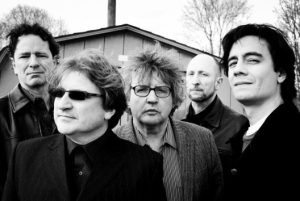
Another of Paul Muldoon’s fascinations has been with popular music. He plays guitar and writes lyrics for the “three-car garage” rock band Rackett, which is described as “Irving Berlin meets blues and boogie-woogie. Cole Porter meets prog and punk. Ira Gershwin meets glam and grunge.” Rackett is soon to release their third CD (If Any of This Gets Out) and they perform at major venues in the New York City area.
Paul Muldoon is married to the writer Jean Hanff Korelitz. They have two children – Dorothy and Asher – and lives in Griggstown, New Jersey.
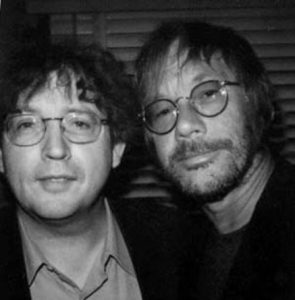
Paul Muldoon is pictured above with the late Warren Zevon. In June 2009 he appeared on the television show “The Colbert Report” (above right) where he and host Stephen Colbert shared a reading of his poem “Tea” (from Madoc: A Mystery), to humorous effect. The poem became the most popular poem in the U.S. after that airing, per Colbert’s announced objective in airing it. Click on http://www.colbertnation.com/the-colbert-report-videos/231220/june-18-2009/paul-muldoon to watch the Colbert interview, which is very funny and will provide wonderful insight into the highly likeable Paul Muldoon.
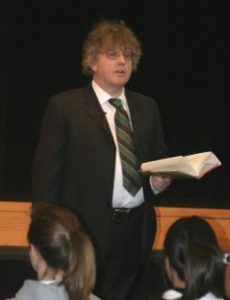
“I think we need to be very careful about just what we mean by difficult. Do we quibble with the latest findings on the mysteries of the universe being difficult, with history being difficult? We know that life is difficult, and while poetry does have to do with clarification, it may be a clarification that includes complexity.”
By RAR
RAR: What have you learned from being a father? Was it something you had always wanted? Or something that just happened to you?
Paul Muldoon: I was thrilled to become a father. It was in some sense something that just happened to me. One minute I was tying the knot. Next thing I knew I was being asked by a doctor if I’d care to cut the umbilical cord. I declined. Politely, of course.
You have written children’s books. Were you moved to write something for your kids? And was there something you “needed” to convey?
I suppose I thought I could learn something from the process. More and more, though, I’m disinclined from the idea of children’s literature and am more taken with the notion that kids should be fed Blake rather than blancmange, Pope rather than pap, Wordsworth rather than waffles.
As a disastrous novelist, I often confess that I haven’t finished anything for 12 years, since my first child was born. How do you work with kids around?
I get them to work for me.
As a writer who loves words, I often get pinged for using words that are too obscure for the average reader. Use of obscure words has been a potent part of your arsenal. Can poets get away with erudition that novelists cannot?
When you say “pinged” are you referring to Nabokov’s “ping-pong Pnin?” I’m still trying to work up the courage to get the phrase “ineluctable modality of the visible” into one of my poems. It’s just not happening for me.
What has it meant to you to have won the Pulitzer for poetry? What have been the best and worst things about it?
The best and worst is that I’m referred to as “the Pulitzer Prize-winning Paul Muldoon.” On one hand, I’m very pleased to have won it. On the other, do you remember who won it last year?
Is there a “Paul Muldoon reader?” A certainly personality type who is inclined toward your brand of witty sophistication? Would you care to describe such a reader?
She’s very like me. With a better haircut.
Your lyrics for Racket connect to a much earlier period of transcontinental jazz, like the brainy works of Cole Porter and, later, Sammy Cahn – three-car garage guys. Do you consciously write rock lyrics pitched to a certain upscale, up-educated target audience? Or are you just having fun with it?
I do like to think that lyrics may be semi-literate. It doesn’t seem to be a problem in the Broadway musical or even country music but, with a few exceptions, it does seem to be a problem in rock’n’roll.
You are a guitarist in Rackett. Are you enamored of the instrument? Any guitars that really get you off?
I love the guitar and what it’s capable of. It changed what we heard, and how we heard it, in the second half of the 20th century. But I’m not really a guitar player. I strum 2 chords and hope for the best.
What differentiates your experience in America from that of your native Ireland? How has it influenced the allusions in your work? And your word choices?
I love American English almost as much as Hiberno-English. I like the idea of speaking, and writing in, a couple of languages. At the same time. I don’t think slipping in and out from one to the other is necessarily a bad thing. I do it every day of the week.
Do you listen to music at home? Is there a certain type, or a certain artist you lean on?
The blues, the blues, the blues.
How old are you in your mind?
I’m 58, but trapped in the body of a 65 year old.
Was poetry something that grabbed you early on? Any particular influences? Do you still enjoy reading the poetry of others?
I started writing poetry at about 14 under the spell of T.S. Eliot. I keep looking for poets who can put me under a spell. And I keep finding them!
Your musical nature has led you to become a librettist several times over. Opera seems like a historical form in a way like your mid-20th century jazz influences. Do you have a romance with the cultural past?
Opera can still be a vital medium, I’m certain. I’m very impressed by what the Metropolitan Opera is doing to try to reconnect the art form with the masses. I was there the other day with my 10 year old son and a woman behind us volunteered how impressed she was by us. I think she withdrew a little when I suggested that going to see the Barber of Seville and Bon Jovi were in the same category of experience.
Do you enjoy being the center of attention? How do you feel when you are on stage with Rackett?
Certainly not the center of attention. I usually have people in to do that for me.
_______________________________
“He makes you feel better,” says Princeton colleague Nigel Smith, a bandmate who writes music to Muldoon’s lyrics. “Things happen when he’s around.”
_______________________________
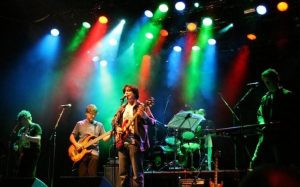
Rackett at the Tavastia Club, Helsinki, Finland, 2009
Your lyrics for Racket connect to a much earlier period of transcontinental jazz, like the brainy works of Cole Porter and, later, Sammy Cahn – three-car garage guys. Do you consciously write rock lyrics pitched to a certain upscale, up-educated target audience? Or are you just having fun with it?
I do like to think that lyrics may be semi-literate. It doesn’t seem to be a problem in the Broadway musical or even country music but, with a few exceptions, it does seem to be a problem in rock’n’roll.
You are a guitarist in Rackett. Are you enamored of the instrument? Any guitars that really get you off?
I love the guitar and what it’s capable of. It changed what we heard, and how we heard it, in the second half of the 20th century. But I’m not really a guitar player. I strum 2 chords and hope for the best.
What differentiates your experience in America from that of your native Ireland? How has it influenced the allusions in your work? And your word choices?
I love American English almost as much as Hiberno-English. I like the idea of speaking, and writing in, a couple of languages. At the same time. I don’t think slipping in and out from one to the other is necessarily a bad thing. I do it every day of the week.
Do you listen to music at home? Is there a certain type, or a certain artist you lean on?
The blues, the blues, the blues.
How old are you in your mind?
I’m 58, but trapped in the body of a 65 year old.
Was poetry something that grabbed you early on? Any particular influences? Do you still enjoy reading the poetry of others?
I started writing poetry at about 14 under the spell of T.S. Eliot. I keep looking for poets who can put me under a spell. And I keep finding them!
Your musical nature has led you to become a librettist several times over. Opera seems like a historical form in a way like your mid-20th century jazz influences. Do you have a romance with the cultural past?
Opera can still be a vital medium, I’m certain. I’m very impressed by what the Metropolitan Opera is doing to try to reconnect the art form with the masses. I was there the other day with my 10 year old son and a woman behind us volunteered how impressed she was by us. I think she withdrew a little when I suggested that going to see the Barber of Seville and Bon Jovi were in the same category of experience.
Do you enjoy being the center of attention? How do you feel when you are on stage with Rackett?
Certainly not the center of attention. I usually have people in to do that for me.
______________________
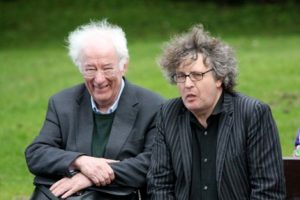
For obvious reasons, you are often referenced with Seamus Heaney. He seems to explore more leaden themes (weighty personal and political), where your work feels more focused on the contemporary (modern life). Do I get that right? And if so, is there any personal dynamic between you and Heaney reflective of these differences? Are you friends?
Very good friends. He was my teacher and I love him deeply.
Your epic poem Madoc: A Mystery explores the notion of utopia; or more to the point, establishing such a place. Doesn’t breathing rare air, or trying to, lead to strange contortions? Can people create a better world, or are we stuck with just doing the best we can with what we have?
We need to do better with what we have since this is all we’ve got.
Is there a blueprint for Rackett? If it were to develop along the lines of some other band you have liked, which would it be?
No blueprint, unfortunately. Which makes me wonder if it isn’t just a terrible idea that no one else has been silly enough to have.
What is your favorite city?
New York.
Who is your favorite singer (any genre)?
Ella Fitzgerald.
Do you return often to Ireland? What is your main impression when you go back?
I go there every other week, it sometimes seems. It’s 5 hours from Newark to Belfast. My main impression is that it’ll only take 5 hours to get back to Newark.
If you suffered complete amnesia and had to start over, what kind of a guy would you choose to be?
I’m very happy with my life. I might still become a monk.
Do you vacation well?
Absolutely. I take a vacation at least once a week.
Should marijuana be legalized?
Marijuana should be legalized and poetry banned.
Do you imagine that we Earthlings will meet an alien civilization within the next 100 years? Or ever?
Possible.
Is there a God?
Yes, but he doesn’t believe in us.
________________________________
On Paul Muldoon
“Muldoon is also noted for his sophisticated handling of poetic form and technique. His approach is both formal and informal, traditional and experimental: he makes use of the lyric poem and the traditional sonnet, but he plays with these forms and combines them with a style of language that is often quite colloquial and familiar. Most of his collections incorporate a diverse array of different forms and styles, along with an equally diverse collection of subject-matter. He is noted for his whimsical, tongue-in-cheek tone (he has described his own work as ‘whimful’), and for his innovative rhyming patterns. Muldoon’s work also abounds with obscure and archaic references and this, combined with his linguistic artfulness, has led some critics to regard his poetry as demanding and inaccessible. Others defend him against such claims: ‘The difficulty of locating the “feeling” in Muldoon’s poetry, of figuring out where he is coming from, is part of the experience of reading his work….’ “
– Clair Wills, Reading Paul Muldoon, 1998
“Muldoon’s linguistic dexterity was immediately apparent, as was his wry humour and his talent for depicting Northern Irish violence in an oblique way, while also exploring personal issues – in fact, Muldoon often shows intimate personal issues as reflective of the wider world. Critics were also keen to link him to Heaney (who taught Muldoon at Queens University, Belfast), for both are Northern Irish poets from rural Catholic backgrounds.”
– Chevalier, Contemporary Poets, 1991
“For all its playfulness, Muldoon’s poetry is also quite hard-hitting, but, as he comments in an oft-quoted remark, this is part of poetry’s function:
‘The point of poetry is to be acutely discomforting, to prod and provoke, to poke us in the eye, to punch us in the nose, to knock us off our feet, to take our breath away.‘”
– Critic Elizabeth O’Reilly
Cows
by Paul Muldoon
Even as we speak, there’s a smoker’s cough
from behind the whitethorn hedge: we stop dead in our tracks;
a distant tingle of water into a trough.
In the past half-hour—since a cattle truck
all but sent us shuffling off this mortal coil—
we’ve consoled ourselves with the dregs
of a bottle of Redbreast. Had Hawthorne been a Gael,
I insist, the scarlet A on Hester Prynne
would have stood for “Alcohol.”
This must be the same truck whose taillights burn
so dimly, as if caked with dirt,
three or four hundred yards along the boreen
(a diminutive form of the Gaelic bóthar, “a road,”
from bó, “a cow,” and thar
meaning, in this case, something like “athwart,”
“boreen” has entered English “through the air”
despite the protestations of the O.E.D.):
why, though, should one taillight flash and flare
then flicker-fade
to an afterimage of tourmaline
set in a dark part-jet, part-jasper or -jade?
That smoker’s cough again: it triggers off from drumlin
to drumlin an emphysemantiphon
of cows. They hoist themselves onto their trampoline
and steady themselves and straight away divine
water in some far-flung spot
to which they then gravely incline. This is no Devon
cow-coterie, by the way, whey-faced, with Spode
hooves and horns: nor are they the metaphysicattle of Japan
that have merely to anticipate
scoring a bull’s-eye and, lo, it happens;
these are earth-flesh, earth-blood, salt of the earth,
whose talismans are their own jawbones
buried under threshold and hearth.
For though they trace themselves to the kith and kine
that presided over the birth
of Christ (so carry their calves a full nine
months and boast liquorice
cachous on their tongues), they belong more to the line
that’s tramped these cwms and corries
since Cuchulainn tramped Aoife.
Again the flash. Again the fade. However I might allegorize
some oscaraboscarabinary bevy
of cattle there’s no getting round this cattle truck,
one light on the blink, laden with what? Microwaves? Hi-fis?
Oscaraboscarabinary: a twin, entwined, a tree, a Tuareg;
a double dung-beetle; a plain
and simple hi-firing party; an off-the-back-of-a-lorry drogue?
Enough of Colette and Céline, Céline and Paul Celan:
enough of whether Nabokov
taught at Wellesley or Wesleyan.
Now let us talk of slaughter and the slain,
the helicopter gunship, the mighty Kalashnikov:
let’s rest for a while in a place where a cow has lain.
__________
“I first heard of Paul Muldoon through the affectionate enthusing of Seamus Heaney…” – from the Literary Journal Ploughshares
__________
Death of a Naturalist
by Seamus Heaney
All the year the flax-dam festered in the heart
Of the townland; green and heavy headed
Flax had rotted there, weighted down by huge sods.
Daily it sweltered in the punishing sun.
Bubbles gargled delicately, bluebottles
Wove a strong gauze of sound around the smell.
There were dragon-flies, spotted butterflies,
But best of all was the warm thick slobber
Of frogspawn that grew like clotted water
In the shade of the banks. Here, every spring
I would fill jampots full of the jellied
Specks to range on the window-sills at home,
On shalves at school, and wait and watch until
The fattening dots burst into nimble-
Swimming tadpoles. Miss Walls would tell us how
The daddy frog was called a bullfrog
And how he croaked and how the mammy frog
Laid hundreds of little eggs and this was
Frogspawn. You could tell the weather by frogs too
For they were yellow in the sun and brown
In rain.
Then one hot day when fields were rank
With cowdung in the grass the angry frogs
Invaded the flax-dam; I ducked through hadges
To a coarse croaking that I had not heard
Before. The air was thick with a bass chorus.
Right down the dam gross-bellied frogs were cocked
On sods; their loose necks pulsed like snails. Some hopped:
The slap and plop were obscene threats. Some sat
Poised like mud grenades, their blunt heads farting.
I sickened, turned, and ran. The great slime kings
Were gathered there for vengeance and I knew
That if I dipped my hand the spawn would clutch it.